Meeting Her Gaze: Women in 20th Century Portraiture
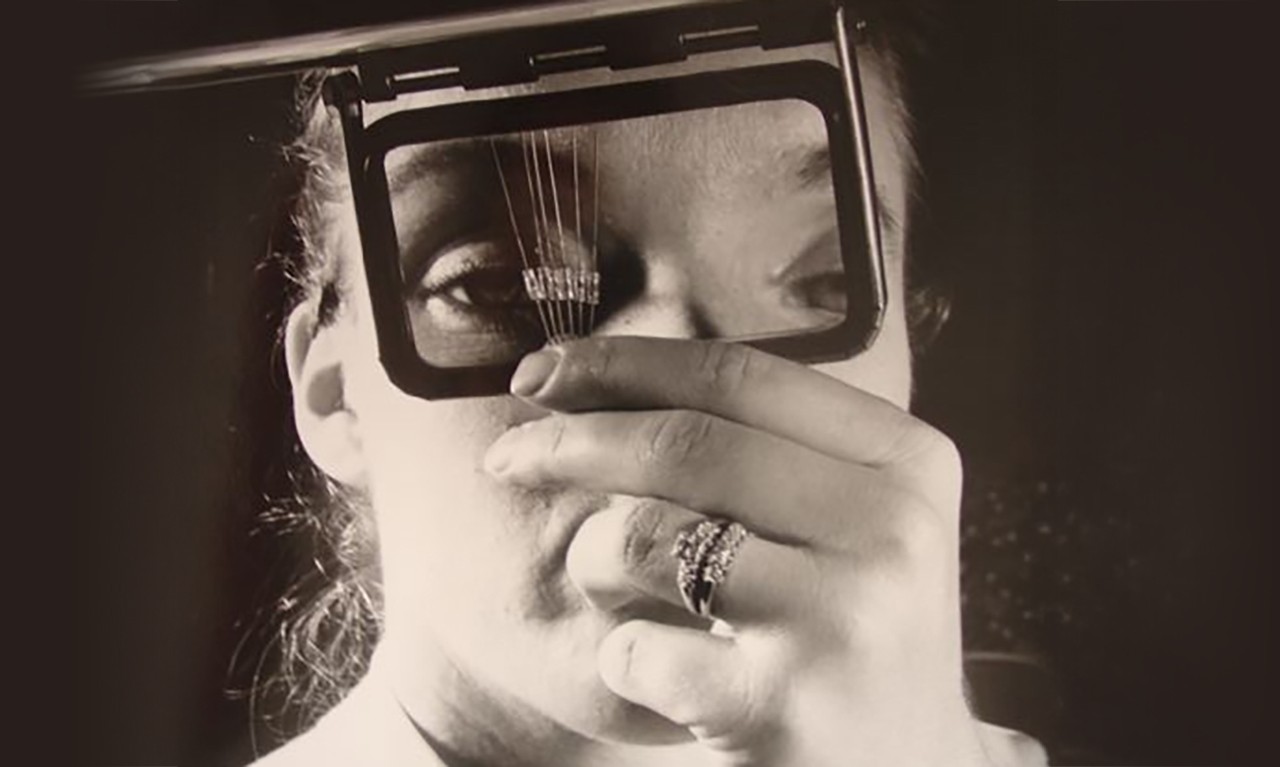 |
| Detail of Untitled (Woman Inspecting Diode) 1950–1960 Los Angeles, California Paper; 8 ½ × 11 in. Hughes Aircraft Company Archives, 92.40.9 |
The Act of Looking
The gaze or the act of looking constitutes a process that reaches beyond the seemingly objective viewing of a subject. Instead, the gaze involves a network of analysis, interpretation, and even self-projection that occurs within both the conscious and subconscious mind. Ultimately serving as evidence for personal autonomy, a hierarchical power structure between the active viewer and the passive viewed subject develops.
Who has historically occupied these roles within portraiture? Traditionally, women were assigned the latter as languid nude portraits of reclining women dominated the art historical canon. Tantalizing, sideways-glancing, and aloof, women within portraiture were employed as objects to feed the desires of viewers, onlookers, and the male gaze alike. However, in the 20th century we begin to observe the impacts of significant sociopolitical reformation represented in portraiture: we begin to meet her gaze.
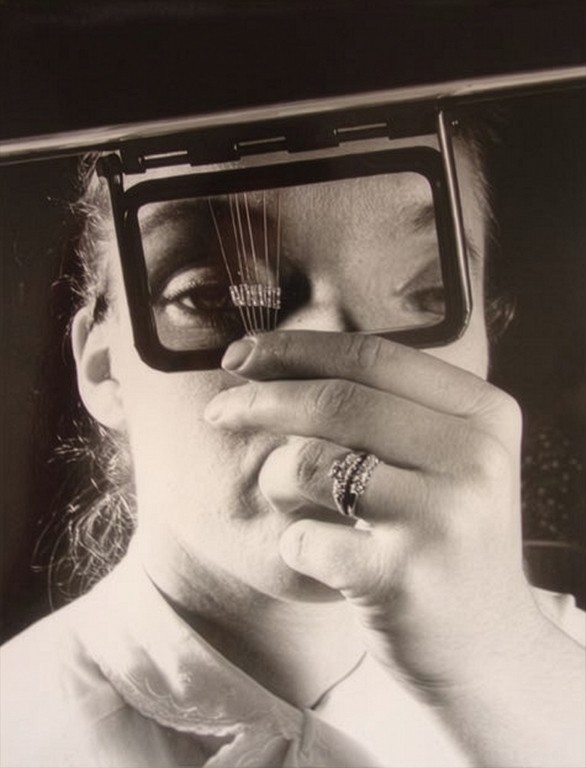 |
| Hughes Aircraft Company Archives, 92.40.9 |
The “New Woman”
Within Bowers’ permanent collection, a woman observing diodes in a black and white photograph from the Hughes Aircraft Archives makes direct eye contact with the viewer. As a result of World War II initiatives, such as the development of the aircraft Spruce Goose, women were employed to manufacture, inspect, and preserve aircrafts and documents produced by the Hughes Aircraft Company. This photograph exemplifies the shifting roles of women from domestic to public spheres during the 20th century.
Peering through the rectangular magnifying glass, the photographed woman holds diodes, a semiconductor device that allows electricity to flow in one direction, between her fingertips. The woman’s face becomes abstracted as the magnifying glass enlarges the appearance of her right eye, while her left eye is partially blocked by the border of the optical device. Although her focus rests on the diodes, the framing of the photograph aligns the woman’s line of sight with the viewer. We hold her gaze as a result.
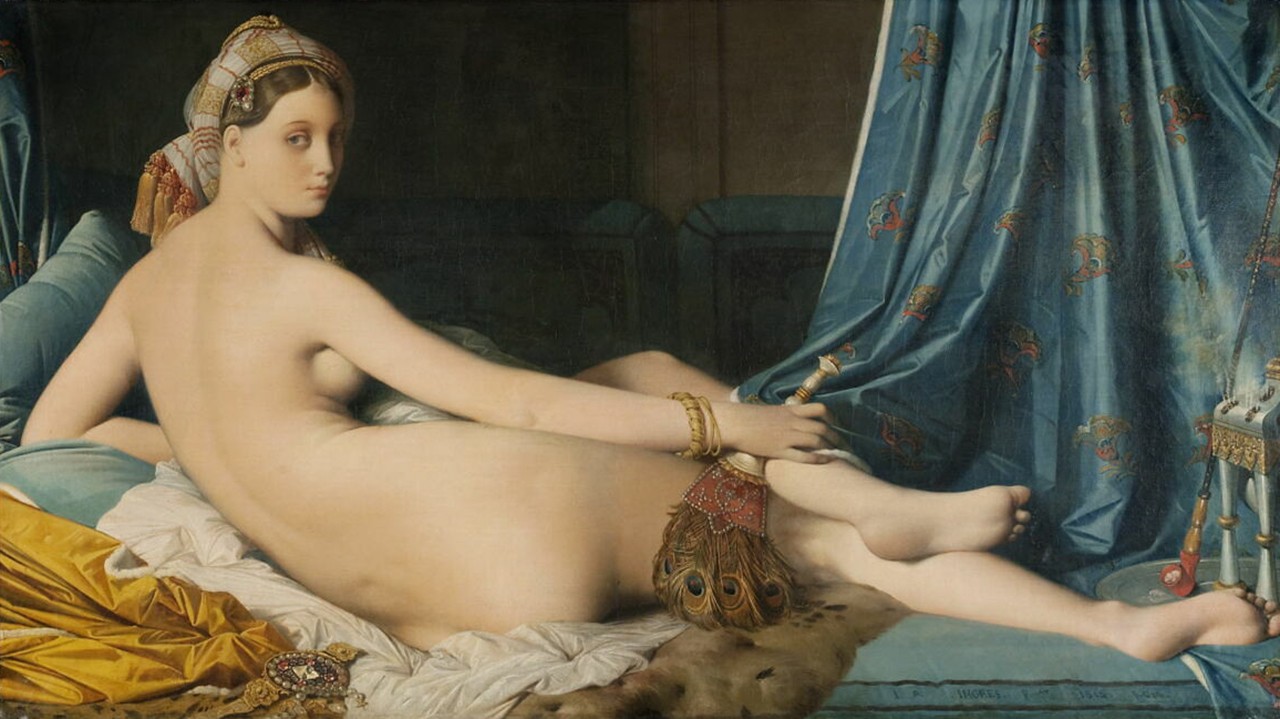 |
| Jean-Auguste-Dominique Ingres French, 1780–1867 La Grande Odalisque 1814 Oil on canvas; 36 × 63 in. © GrandPalaisRmn (musée du Louvre) / Hervé Lewandowski, RF 1158 |
Departing from 19th century portraits of women, such as Ingres’ La Grande Odalisque, the woman in this 20th century photograph is depicted actively engaging in an inspection for the Hughes Aircraft Company. Rather than an object of desire, she is portrayed as a woman with purpose. Despite the revisioning of gender roles within this portrait, the woman’s left hand, accented by the prominent display of her glittering wedding ring, obstructs the lower half of her face. Signifiers alluding to domesticity are not erased but diminished, as the 20th century “New Woman” archetype influenced a generation of women to simultaneously maintain a professional and family life. Meeting her gaze through a distorted framework, the woman depicted in this photograph exhibits a form of autonomy deemed appropriate by the shifting collective consciousness of the 1950s and ‘60s.
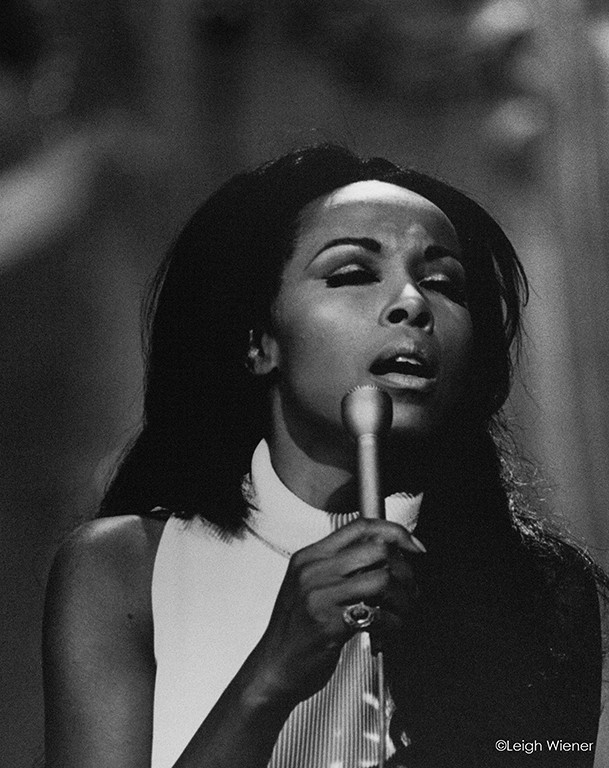 |
| Leigh A. Wiener American, 1929–1993 Diahann at the Palace 1968 Los Angeles, California Gelatin silver print on ektalure paper; 20 × 16 in. Gift of Leigh A. Wiener. ©Leigh Wiener / 7410 Inc. All rights reserved, 87.6.25 |
Refocusing the Public Eye
In the beginning of the Civil Rights Movement, significant political reform—witnessed in cases such as Brown v. Board of Education—took place. However, cultural reform remained stagnant and seemingly immutable. Despite these circumstances, Diahann Carroll flourished.
As a singer, activist, actress, Tony Award and Golden Globe winner, Carroll’s cultural impact prevails beyond her lifetime. Taking ownership and control over how she was represented during her stardom, she actively combated one-dimensional, stereotypical, and racist representations of Black individuals within mass media. The camera, wielded by Leigh Wiener, strategically contributed to Carroll’s reclamation of mainstream Black representation.
At the height of his career, Wiener captured the 20th century through portraits of presidents, poets, musicians, scientists, and industry titans. Approaching photography with adept technical skill, he further sought to build a relationship with the people he photographed, stating, “A portrait is not a duplication of a face. A portrait is the revelation of a person.” Wiener’s photograph, Diahann at the Palace, fulfills such sentiments.
With eyes closed, lips parted, and glinting microphone in hand, Wiener documents Carroll’s performance at the Hollywood Palace for an ABC advertisement. Utilizing a shallow depth of field, Wiener focuses on Carroll’s meditative and introspective expression—coercing the viewer to join her headspace, not extract from it. Existing within the intersectional confines of race and gender, as discussed by scholar and activist Kimberlé Crenshaw, Black women within the media were subjected to fetishization, objectification, and dehumanization. However, from physical appearance to performance, Carroll refocused the viewer’s gaze to acknowledge her multifaceted talents, prowess, and humanity during a time when it was systemically and culturally denied.
Dismantling The Gaze
Through the examination of 20th century photographs, we can begin to observe the transformation of “woman as desired object” to woman as subject of her own interests within portraiture. Dismantling the voyeuristic gaze begins at the rudimentary return of acknowledgment, diminishing in power and control as we meet her gaze.
Guest written by Lauren Bugay. Text and images may be under copyright. Please contact Collection Department for permission to use. References are available on request. Information subject to change upon further research.
Comments 1
Great read!